

Alternative data is defined as any non-traditional information source used to generate investment signals outside of standard financial statements, earnings reports, and economic releases. The role of alternative data investing has expanded from a niche institutional practice into a market-wide standard, with 90% of private fund managers now using it, up from 67% the prior year, across a $15 billion global market. Sources range from satellite imagery and credit card transaction feeds to hiring trend data and geolocation signals. For individual investors, understanding how this data category works is no longer optional. It defines who sees market moves early and who reacts late.
How does alternative data enhance investment decision-making?
Alternative data provides a timing advantage that traditional financial reporting cannot match. Official earnings releases, 10-Q filings, and macroeconomic reports reflect conditions from weeks or months prior. Real-world signals from alternative data arrive days or weeks before those reports, giving investors who act on them a measurable lead over the broader market. That lead translates directly into better entry and exit timing, tighter risk controls, and stronger risk-adjusted returns.
Satellite imagery and transaction data in practice
Satellite imagery of retail parking lots, shipping ports, and oil storage facilities gives analysts a ground-level view of economic activity before any company reports it. Credit card spending data from aggregators tracks consumer behavior in near real time, allowing portfolio managers to model revenue trajectories for retailers, restaurants, and travel companies well ahead of quarterly disclosures. For example, a spike in spending at a specific airline's booking platform, visible in transaction data, can signal a revenue beat weeks before the earnings call. Kresmion's research on American Airlines signals illustrates how timing advantages from these sources translate into concrete investment insights.

Hiring trend data adds another layer. When a company posts a surge in engineering or logistics roles on job boards, that signals expansion plans not yet reflected in any filing. Workforce signals like these have become standard inputs for growth forecasts at major hedge funds. 63% of buy-side investors plan to increase spending on alternative data in 2025, a figure that reflects how central these signals have become to competitive portfolio construction.
AI and machine learning are the engines that make this data usable at scale. Raw alternative datasets are often enormous and unstructured. Firms like Citadel transform large, noisy datasets using AI and ML into decision-ready insights that generate alpha across multiple asset classes. Without that transformation layer, the raw data is noise. With it, the same data becomes a repeatable edge.
Pro Tip: Do not evaluate alternative data by volume alone. A single, well-cleaned transaction dataset with a clear signal thesis will outperform ten poorly integrated sources every time.
What are the main types and sources of alternative data?
Alternative data falls into several distinct categories, each serving different investment strategies and asset classes. Understanding the differences helps you match the right data type to your specific research question.
| Data type | Source | Primary use case | Reporting lag vs. traditional data |
|---|---|---|---|
| Consumer transaction data | Credit card aggregators, payment processors | Revenue forecasting for retail, travel, food service | Days vs. 90 days for quarterly earnings |
| Geolocation data | Mobile device signals, foot traffic trackers | Store performance, supply chain activity | Weekly vs. monthly government data |
| Satellite imagery | Commercial satellite providers | Commodity inventory, construction activity, retail traffic | Near real time vs. monthly reports |
| Workforce signals | Job posting aggregators, LinkedIn activity | Expansion plans, R&D investment, headcount trends | Weekly vs. annual reports |
| Sentiment data | Social media, news feeds, earnings call transcripts | Short-term price catalysts, management tone shifts | Hours vs. days for analyst notes |
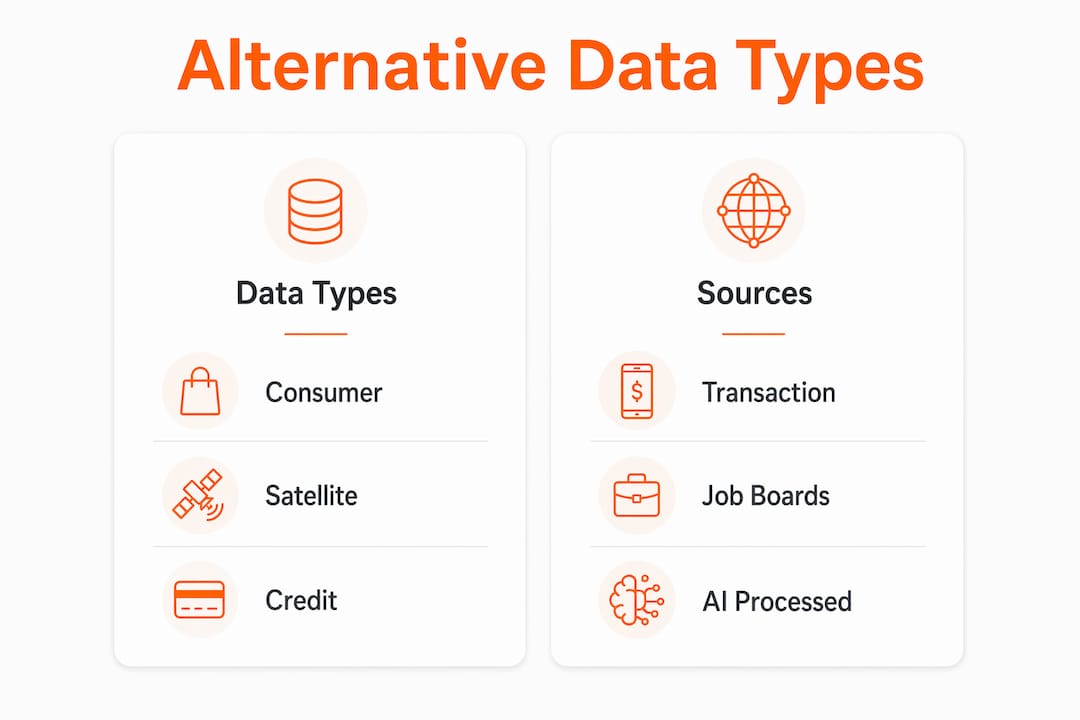
The contrast with traditional data is stark. A quarterly earnings report tells you what happened three months ago. Satellite imagery of a retailer's distribution center tells you what is happening today. This is why the importance of alternative data has grown so sharply across equities, fixed income, and macro investing.
Credit and lending represent one of the clearest demonstrations of this impact. Alternative credit data complements traditional bureau scores by incorporating real-time consumer behaviors, providing a fuller picture for risk assessment. Traditional data alone fails to score between 20% and 49% of applicants, a gap that alternative sources close by capturing rent payments, utility history, and bank account cash flows. The same principle applies to equity investing: traditional data leaves gaps that alternative sources fill with precision.
Data "productization" is the process by which raw alternative datasets get cleaned, normalized, and packaged into usable signals. Firms that invest in this operationalization step gain a structural advantage. Those that simply purchase raw data without building the infrastructure to process it often find the data adds cost without adding insight.
What challenges and risks come with integrating alternative data?
The impact of alternative data on investment outcomes is real, but so are the operational and governance risks that come with it. Investors who treat alternative data as a plug-and-play solution consistently underestimate the complexity involved.
-
Data quality and cleaning. Most alternative datasets arrive messy, inconsistent, and full of gaps. A geolocation feed may have coverage gaps in rural markets. A transaction dataset may double-count certain merchant categories. Without rigorous cleaning pipelines, these errors propagate into models and distort signals.
-
Governance, provenance, and auditability. Governance credibility requires sourcing transparency, data lineage tracking, and full auditability of every decision made from a dataset. Regulators and institutional risk teams increasingly demand this documentation. Without it, a firm cannot defend its investment decisions or reproduce its results.
-
Model risk exposure. When AI and ML models are trained on alternative data, errors in the underlying data compound into model errors. Integrating alternative data with AI increases model risk and governance challenges, requiring disciplined controls and auditable decision-making at every stage of the pipeline.
-
Legal and data rights considerations. Not all alternative data is legally clean. Web-scraped data, personal location data, and certain transaction feeds carry regulatory exposure depending on jurisdiction. Investors must verify data rights before building production systems on any new source.
-
Signal decay. Alternative data edges erode as more participants adopt the same sources. A satellite imagery signal that generated alpha in 2020 may be fully priced in by 2026 because dozens of funds now use the same provider. Continuous signal validation and model updating are not optional maintenance tasks. They are core to sustaining any edge.
Pro Tip: Build a data provenance log from day one. Documenting where each dataset came from, how it was cleaned, and which model versions used it will save you significant time during audits and model reviews.
How can investors implement alternative data strategies effectively?
Effective implementation of alternative data in financial analysis requires more than purchasing a data feed. 90% of investment teams now use at least two alternative datasets, which means the edge no longer comes from access alone. It comes from the signal thesis and operational depth behind the data.
The steps below reflect what separates firms that generate durable alpha from those that simply add data costs to their P&L.
-
Develop a signal thesis before acquiring data. Define the specific investment question you are trying to answer. "What does foot traffic at Home Depot locations tell us about same-store sales growth?" is a signal thesis. "We should buy satellite data" is not. The thesis drives every subsequent decision about sourcing, cleaning, and modeling.
-
Build infrastructure for data ingestion and cleaning. A data pipeline that ingests, normalizes, and versions alternative datasets is a prerequisite for production use. Without version control on your data, you cannot reproduce past results or diagnose model failures.
-
Integrate investment and data teams. The most effective alternative data programs pair portfolio managers with data engineers and quantitative analysts. Portfolio managers define the investment hypothesis. Data teams build the extraction and modeling infrastructure. Neither group succeeds without the other.
-
Use AI and ML for signal extraction, not just data processing. Machine learning models can identify non-linear relationships in alternative data that traditional statistical methods miss. Natural language processing applied to earnings call transcripts, for instance, can detect shifts in management tone that precede guidance changes. Kresmion's research on Axcelis Technologies signals demonstrates how composite signals built from multiple data inputs improve earnings forecast accuracy.
-
Validate and update signals continuously. A signal that worked for 18 months may stop working as market participants adapt. Schedule regular backtesting reviews, monitor signal decay metrics, and retire signals that no longer generate statistically significant alpha.
The benefits of alternative investing compound over time when this infrastructure is in place. Each new dataset added to a well-built system generates marginal signal value at lower incremental cost. Firms that skip the infrastructure step pay full cost for each new dataset and capture only a fraction of its potential value.
Key takeaways
Alternative data gives investors a measurable timing advantage over traditional financial reporting, but only when paired with disciplined signal development, clean data infrastructure, and credible governance frameworks.
| Point | Details |
|---|---|
| Timing advantage is the core value | Alternative data delivers real-world signals days or weeks before official reports, enabling earlier and more accurate investment decisions. |
| Signal thesis drives the edge | Owning the right internal hypothesis matters more than the data source itself, since 90% of teams now use multiple datasets. |
| Governance is non-negotiable | Sourcing transparency, data lineage, and auditability are front-office requirements, not back-office formalities. |
| AI amplifies but also complicates | Machine learning unlocks scale and pattern recognition but increases model risk, requiring disciplined controls at every pipeline stage. |
| Signal decay demands continuous work | Alternative data edges erode as adoption spreads, making ongoing validation and model updating a permanent operational requirement. |
Why the governance layer is the part most investors get wrong
I have watched investors build impressive alternative data programs, spend heavily on satellite feeds and transaction datasets, and then quietly abandon them 18 months later. The failure point is almost never the data itself. It is the absence of a governance layer that makes the data trustworthy enough to act on at scale.
The industry conversation focuses heavily on which datasets to buy and which AI models to run. That is the exciting part. What gets far less attention is the unglamorous work of documenting data lineage, building reproducible pipelines, and maintaining audit trails that can survive regulatory scrutiny. Deloitte's research on data governance for competitive advantage makes the point clearly: governance credibility is what separates firms that sustain an alternative data edge from those that generate one-time alpha and then watch it evaporate.
My honest view is that alternative data has already crossed the threshold from competitive edge to standard infrastructure. If you are not using it, you are not competing on equal terms. But using it badly, without governance, without signal discipline, without model risk controls, is worse than not using it at all. Bad data fed into a confident model produces confident wrong answers. That is a more dangerous outcome than simply having no signal.
The investors who will win the next decade are not the ones with the most data. They are the ones who have built the operational discipline to know which data to trust, when to trust it, and when to retire a signal that has stopped working. That discipline is harder to build than any data pipeline, and it is far harder to copy.
— Solal
See how Kresmion puts alternative data signals within reach
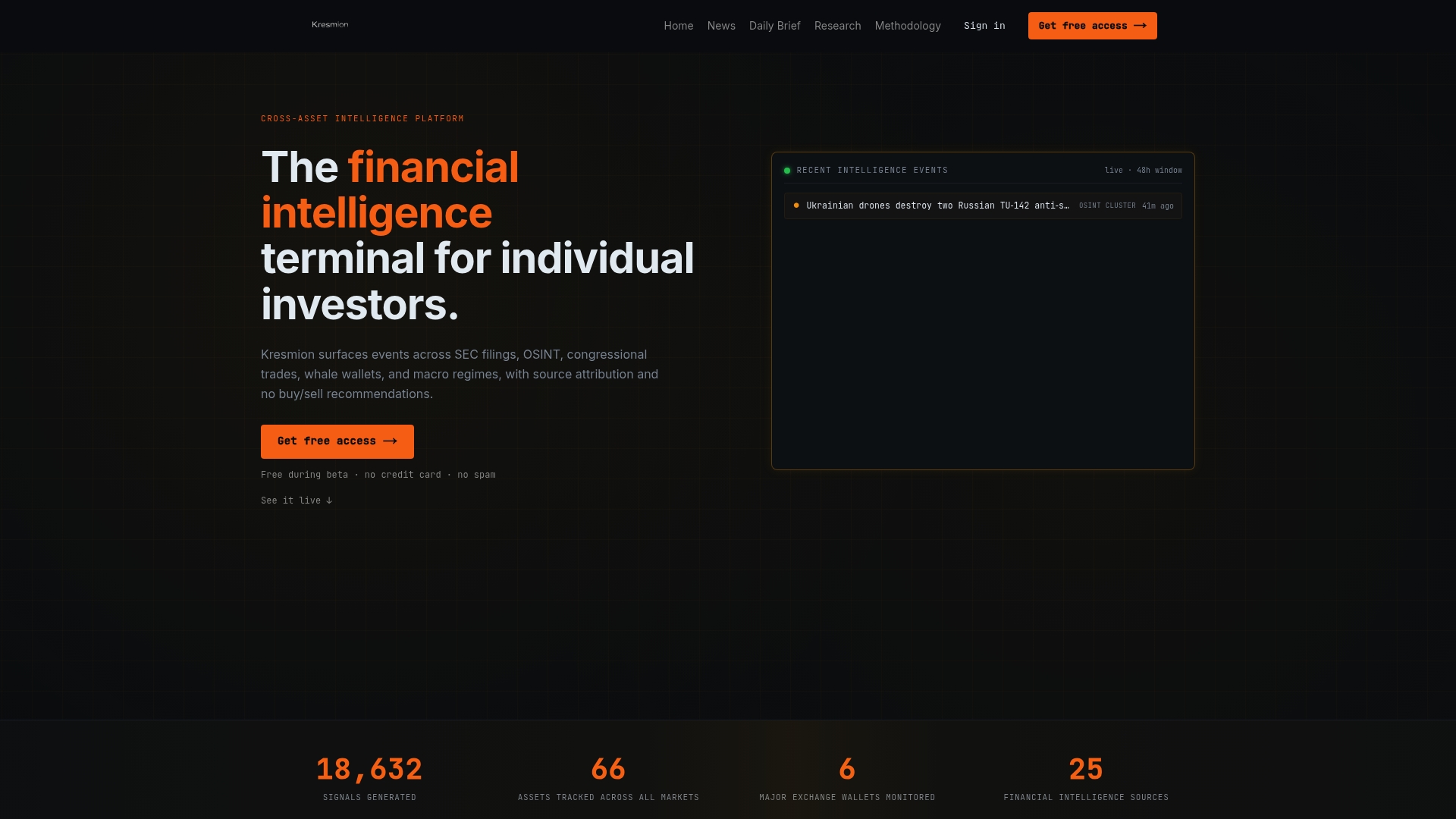
Most alternative data tools are built for institutional desks with seven-figure data budgets. Kresmion is built for individual investors who want the same quality of signal without the institutional price tag. The platform aggregates data from SEC filings, congressional trades, and whale wallet movements into composite signals you can analyze directly, without any buy or sell bias baked in. The macro regime tracking layer lets you understand market dynamics before they show up in mainstream reporting. If you want to see how alternative data signals apply to specific companies, the Accel Entertainment research page is a practical starting point for understanding how these signals work in a real investment context.
FAQ
What is alternative data in investing?
Alternative data refers to non-traditional information sources used to generate investment signals, including satellite imagery, credit card transaction feeds, geolocation data, workforce signals, and sentiment analysis. It differs from traditional financial data by providing real-time or near-real-time insights rather than backward-looking reports.
How does alternative data affect investment returns?
Alternative data delivers a timing advantage by surfacing real-world signals days or weeks before official financial disclosures, which improves earnings forecast accuracy and supports better risk-adjusted portfolio construction. The impact depends heavily on signal quality and the operational infrastructure used to process the data.
What are the biggest risks of using alternative data?
The primary risks include data quality issues, model risk from AI integration, legal exposure from improperly sourced datasets, and signal decay as more market participants adopt the same sources. Governance and auditability are the most commonly underestimated risk factors.
Can individual investors access alternative data?
Individual investors historically lacked access to institutional-grade alternative data due to cost and infrastructure barriers. Platforms like Kresmion now aggregate composite signals from SEC filings, congressional trades, and other non-traditional sources, making this category of intelligence accessible without a Bloomberg-level budget.
How do I know if an alternative data signal is still valid?
Signal validity requires continuous backtesting, decay monitoring, and comparison against live market outcomes. A signal that generated statistically significant alpha 18 months ago may be fully priced in today, so scheduled validation reviews are a core operational requirement rather than an optional audit.