

Unbiased investment signal sources are platforms, tools, or data streams that deliver transparent, fact-based market information without embedded buy/sell recommendations or hidden commercial agendas. For individual investors, the distinction matters enormously. Investment scams cost Americans $7.9 billion in 2025 alone, with the median victim losing more than $10,000. That figure reflects how many retail traders are paying for signals that serve the seller, not the buyer. The most credible unbiased investment signal sources share three traits: verifiable raw data, clear risk disclosures, and no financial incentive to push you toward a specific trade.
1. Why primary filings are the most trustworthy investment signals
SEC filings are the gold standard for objective investment insights because they are legally required disclosures, not marketing materials. A company's 10-K (annual report), 10-Q (quarterly report), and Form 4 (insider transactions) give you the raw evidence that every analyst, fund manager, and algorithm eventually prices into the market. Reading them directly removes one layer of interpretation and one layer of potential bias.
The practical challenge is that filings are dense. Tools like AlphaSense's AI channel checks address this by surfacing relevant transcript excerpts with full source citations and direct links back to the original document. That auditability is the key differentiator. A summary without a source is an opinion. A summary with a traceable citation is a signal.
- Form 10-K: Annual business overview, risk factors, and audited financials. Read the risk factors section first.
- Form 10-Q: Quarterly updates. Compare sequential quarters for revenue trend shifts.
- Form 4: Insider buying or selling. Cluster purchases by multiple insiders carry more weight than single transactions.
- 13F filings: Institutional holdings reported quarterly. Useful for tracking where large funds are concentrating positions.
Pro Tip: Verify any company's registration status and check for disciplinary history at Investor.gov or the CFTC's database before acting on any signal tied to that company. This takes under two minutes and filters out a significant share of fraudulent sources.
2. How institutional macro commentaries work as neutral market signals

Institutional macro commentary, published weekly by organizations like the BlackRock Investment Institute, represents one of the most accessible forms of independent market signals available to retail investors at zero cost. BlackRock's weekly outlooks frame market scenarios around explicit assumptions and defined time horizons, without issuing direct trading calls. That structure is what makes them useful as neutral investment indicators rather than noise.
The key is reading these documents analytically rather than reactively. When BlackRock describes a "preference for short-duration bonds," that is a macro thesis built on rate assumptions, not a trade recommendation. Your job is to extract the underlying logic and test it against your own portfolio context.
- Look for the stated assumptions behind every view. If the assumption changes, the outlook changes.
- Note the time horizon. A 6-to-12-month strategic view is irrelevant to a 3-week trade.
- Track how the commentary evolves week over week. Shifts in language often precede shifts in positioning.
- Cross-reference institutional outlooks with primary filing data to confirm or challenge the macro narrative.
Pro Tip: Read the "Our bottom line" section of any institutional commentary first, then work backward through the supporting logic. This prevents you from being anchored by the narrative before you evaluate the evidence.
3. How screeners generate unbiased candidate lists without replacing analysis
Investment screeners are candidate generators, not final arbiters. Fidelity's research guidance makes this explicit: screeners shortlist candidates efficiently, but they do not replace validation through primary company information and financial statements. Treating a screener output as a buy signal is the most common mistake retail traders make with these tools.
Fidelity's Equity Summary Score aggregates ratings from multiple independent research providers into a single consensus score. The value is not the score itself but the spread. A stock with three strong buys and two strong sells tells a different story than one with five moderate holds. Examining the disagreement between analysts reveals where uncertainty lives, and uncertainty is where independent research creates an edge.
The limitation of any consolidated rating is that it reflects backward-looking data. Screeners built on price-to-earnings ratios, revenue growth, or momentum factors are measuring what already happened. The separation of evidence collection from synthesis is what prevents screener bias from becoming portfolio bias. Use the screener to find names. Use filings and macro context to decide.
- Set screener filters based on objective criteria: revenue growth rate, debt-to-equity ratio, free cash flow yield.
- Export the candidate list and research each name independently before forming a view.
- Avoid screeners that rank stocks by "analyst consensus" without showing the underlying individual ratings.
- Confirm screener data against the company's most recent 10-Q before acting.
4. Why cost transparency is a signal quality test
The cost of a signal subscription is itself a data point about the provider's incentives. Index mutual funds average an expense ratio of 0.05%, compared to 0.64% for actively managed equity funds. On a $5,000 investment, that translates to roughly $2.50 versus $32 per year. This spread is your baseline for evaluating any paid signal service.
If a signal subscription costs more than the fee difference between passive and active management, the provider must demonstrate clear, measurable added value. Most cannot. Subscription costs should be benchmarked against this passive-to-active fee gap to assess whether the service is genuinely cost-effective or simply expensive.
| Signal source type | Approximate annual cost | Value benchmark |
|---|---|---|
| SEC filings (EDGAR) | Free | Highest raw reliability |
| Institutional macro commentary | Free | Non-prescriptive, high credibility |
| Brokerage screeners (e.g., Fidelity) | Free with account | Efficient candidate generation |
| AI-driven research tools | $500 to $3,000+ | Must outperform passive fee drag |
| Paid signal rooms or newsletters | $200 to $5,000+ | Highest scrutiny required |
Pro Tip: Before subscribing to any paid signal service, ask for a documented track record with entry dates, exit dates, and position sizes. Providers who cannot supply this are selling narrative, not signals.
5. Comparing unbiased signal source types side by side
Not every source fits every investor. The table below maps the four major categories of objective investment insights against the criteria that matter most for retail traders.
| Source type | Reliability | Transparency | Cost | Best for |
|---|---|---|---|---|
| SEC filings (10-K, 10-Q, Form 4) | Very high | Very high | Free | All investors, especially long-term |
| Institutional macro commentary | High | High | Free | Long-term and macro-focused traders |
| Brokerage screeners | Moderate | Moderate | Free to low | Beginners and active traders |
| AI-driven channel checks | High | High (with citations) | Medium to high | Active traders with research budgets |
| Paid signal newsletters | Variable | Low to medium | Medium to high | Requires rigorous vetting |
The pattern is clear. Free, primary-source tools consistently score highest on both reliability and transparency. Paid services require proportionally more scrutiny. Clear risk disclosure is the single fastest filter: any signal provider that downplays risk or buries disclosures in fine print is not operating as an unbiased source.
6. Matching signal sources to your investing style and budget
The right combination of trustworthy investment alerts depends on your time horizon, technical comfort, and how much you are willing to spend. There is no universal answer, but there are clear patterns by investor type.
For cost-conscious beginners: Start with SEC EDGAR for filings, Investor.gov for registration checks, and your brokerage's built-in screener. These three resources cost nothing and cover the fundamentals of independent market signals. Fidelity, Schwab, and Vanguard all provide free research tools that meet a basic standard of objectivity.
For active traders: Layer in AI-driven research tools that provide source-cited transcripts and channel checks. The auditability of tools like AlphaSense separates them from black-box signal providers. Combine these with weekly institutional macro commentary to contextualize individual stock signals within broader market conditions.
For long-term investors: Institutional macro commentary and index fund research are your primary inputs. The FTC advises checking licenses and registrations before engaging any paid provider, a step that eliminates most scam-adjacent services immediately.
- Avoid any provider that guarantees returns or uses urgency tactics to push subscriptions.
- Treat any signal that lacks a verifiable source citation as unconfirmed opinion.
- Build a workflow that separates data collection from interpretation. Single-vendor signals collapse this separation and introduce bias by design.
Key takeaways
The most reliable unbiased investment signal sources are free, primary-source tools like SEC filings and institutional macro commentary, with paid services requiring documented track records and cost benchmarking against passive fund fee drag before they earn a place in your research workflow.
| Point | Details |
|---|---|
| Primary filings are the baseline | SEC 10-K, 10-Q, and Form 4 filings provide legally required, unfiltered evidence for any investment thesis. |
| Institutional commentary is non-prescriptive | BlackRock and similar outlooks frame scenarios with explicit assumptions, not buy/sell calls. |
| Screeners generate candidates, not conclusions | Use Fidelity or similar tools to shortlist names, then validate each with primary source data. |
| Cost is a credibility signal | Benchmark any paid subscription against the 0.05% to 0.64% index-to-active fund fee spread. |
| Auditability separates signals from noise | Source-cited, transcript-backed tools like AlphaSense are verifiable. Black-box summaries are not. |
What I've learned from years of reading signals wrong
I spent the first two years of serious investing confusing narrative with evidence. I would read a well-written macro commentary, feel convinced by the argument, and then act on the conclusion without checking whether the underlying data actually supported it. That is the trap most retail investors fall into, and it is not a knowledge gap. It is a workflow gap.
The shift that changed my approach was treating signal sources as inputs to a structured process rather than conclusions to act on. I now read SEC filings before I read any analyst commentary on a company. The filing tells me what actually happened. The commentary tells me how someone interpreted it. Those are two very different things, and conflating them is where bias enters.
I am genuinely skeptical of paid signal rooms and subscription newsletters that do not publish verifiable track records. The FTC's data on investment fraud is not abstract. It describes real people who trusted sources that looked credible but lacked any accountability mechanism. Auditability, the ability to trace a signal back to its original source document, is the single most important quality marker I apply when evaluating any new provider.
The practical workflow I use now: collect raw evidence from filings and screeners, cross-reference with one or two institutional macro outlooks, and only then form a view. This separation is not complicated. It just requires discipline. Kresmion's approach to aggregating 13F filings and regulatory data into a single interface reflects exactly this philosophy, and it is why I find it worth recommending to retail investors who want the process without building it from scratch.
— Solal
How Kresmion puts unbiased signals in one place
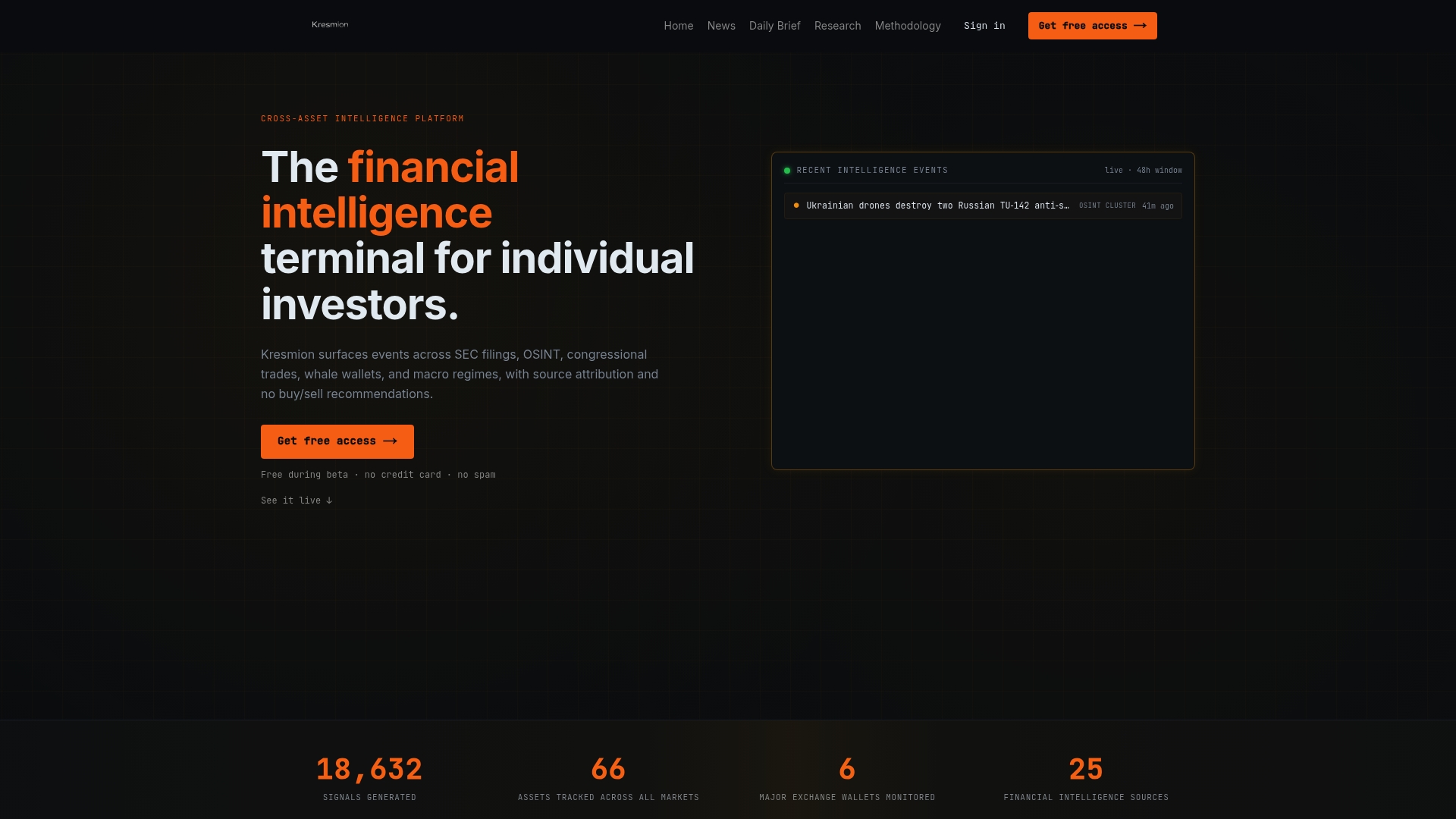
Kresmion is built specifically for individual investors who want institutional-grade signal data without institutional price tags. The platform aggregates SEC filings, 13F institutional holdings, congressional trade disclosures, and macro regime indicators into a single interface, giving you the raw evidence layer that most retail traders never access. There are no buy/sell recommendations. There is no hidden agenda. You can explore verified primary data for individual tickers directly, or start with the Kresmion main platform to understand how composite signals work across asset classes. For retail investors who want to research like a professional without paying Bloomberg prices, this is the practical starting point.
FAQ
What makes an investment signal source truly unbiased?
A truly unbiased signal source provides verifiable, source-cited data without embedded buy/sell recommendations or financial incentives tied to your trading decisions. The FTC identifies clear risk disclosure as a hallmark of trustworthy providers.
Are free signal sources as reliable as paid ones?
SEC filings and institutional macro commentaries from organizations like the BlackRock Investment Institute are free and consistently rank higher on transparency and reliability than most paid signal newsletters. Cost does not correlate with accuracy.
How do I verify if a signal provider is legitimate?
Check the provider's registration status at Investor.gov or the CFTC database before subscribing to any service. Any legitimate investment signal provider will have a verifiable regulatory record and a documented performance history.
What is the biggest red flag in a paid signal service?
Any provider that downplays risk, guarantees returns, or refuses to share a verifiable track record with entry and exit dates is operating outside the standards of credible, unbiased financial advice.
How should I use screeners without introducing bias?
Use screeners like Fidelity's Equity Summary Score to generate a candidate list based on objective criteria, then validate each candidate independently using primary SEC filings before forming any investment thesis.